
You started dropshipping the way most people do: a marketplace supplier, an app, a few products. Then the problems began. Shipping times crept up. Quality varied from one order to the next. A supplier ran out of stock in the middle of a good sales week. At some point a more experienced seller says the words that change how you think about it: “You need a private agent in China.”
If that is the stage you are at, this guide is for you. It explains what a private agent actually does, when it makes sense to switch, how to choose one without getting burned, and what to ask before you send a single dollar. At the end we also share two agents we have worked with for more than five years across client stores.
Some links in this article are affiliate links. If you sign up through them, we may earn a commission at no extra cost to you. We only recommend services we have used ourselves.
What is a private agent in China?
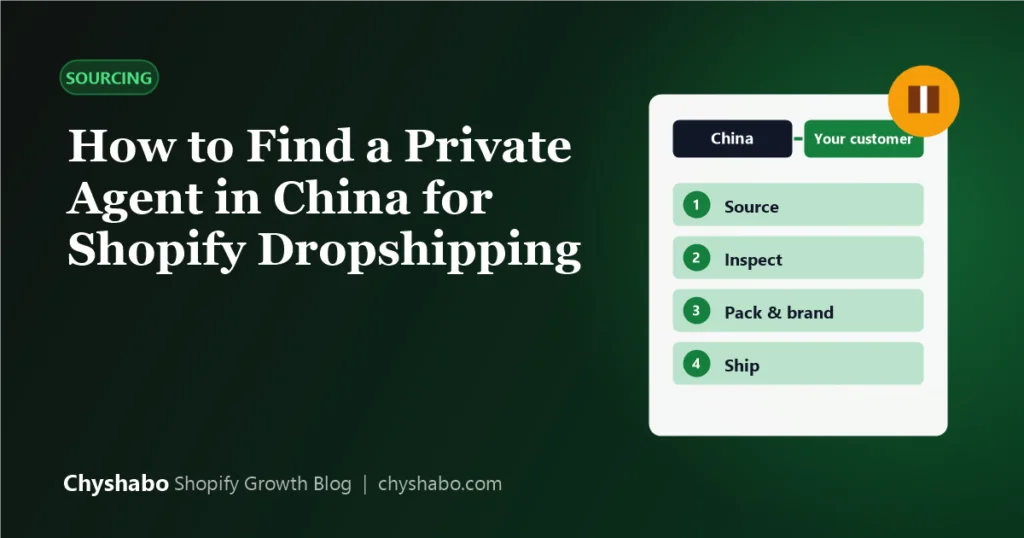
A private agent (also called a sourcing agent or purchasing agent) is a company or person in China who buys products on your behalf. Instead of you ordering from a marketplace listing, you tell the agent what you want to sell. They find the supplier, negotiate, buy the goods, check them, pack them and ship them to your customers.
Think of them as your team on the ground. You cannot visit factories in Shenzhen or Yiwu every week, speak the language of every supplier or inspect every parcel. A good agent does those things for you, and does them at the volume of an online store, which is small orders going to many different countries.
Marketplace suppliers vs a private agent
Marketplace and app-based suppliers are a fine place to start. They are quick to set up and need no commitment. But as a store grows, three weaknesses tend to show up:
- Consistency. The listing you tested is not always the product that arrives in month six.
- Control. You rarely get to inspect the item, change the packaging or add your own branding.
- Price and speed. With volume, a private agent can often negotiate better prices and choose better shipping lines than a generic listing gives you.
A private agent does not automatically beat a marketplace. For a first test of a product, a marketplace is often the cheaper way to find out if anyone wants it. The switch tends to make sense once you have a product that sells and you want quality, branding and reliability.
Signs it is time to work with an agent
- You have a winning product and orders are coming in every day.
- Customers complain about quality or long delivery times, and refunds are eating into your profit.
- You want your own packaging, your own label or a product that looks different from every other store.
- You are ordering in larger quantities and want a better price per unit.
- You are tired of managing orders by hand across several suppliers.
What a good private agent actually does
Agents differ, but the services you should look for are these:
- Sourcing and price negotiation. Finding reliable suppliers and getting fair prices.
- Purchasing. Paying suppliers and handling the paperwork inside China.
- Quality checks. Inspecting products before they ship, ideally with photos or video sent to you.
- Consolidation. Combining items from different suppliers into one parcel for your customer.
- Packaging and branding. Custom packaging, inserts, labels and, for private label and white label products, your own branding.
- Storage. Holding stock in a warehouse in China so orders can go out quickly.
- Shipping. Choosing carriers and shipping lines and giving you tracking numbers.
- Order processing. Taking orders from your store and fulfilling them, ideally with an automatic connection to Shopify.
How to choose an agent: 12 questions to ask
Before you commit, ask any agent these questions. The answers, and how clearly they are given, tell you a lot.
- How do you charge? Some charge a service fee or commission on each order, some build a margin into the product price, some do both. Ask for it in writing.
- Is there a minimum order? Some services work with single units, others need quantities.
- Can I order samples? Always test the product yourself before you sell it.
- How do you check quality? Ask what is inspected, and whether you get photos or video before shipping.
- Which shipping lines do you use, and how long do they take to my main markets? Ask for real examples, not best-case numbers.
- Do you give tracking numbers, and can they be sent automatically?
- What happens when something goes wrong? Ask about damaged, lost and wrong items, refunds and compensation.
- Can you customise packaging and add my branding? Ask about minimums for custom boxes and labels.
- Do you connect to Shopify? An automatic order connection saves hours every week.
- How do I pay? Find out which payment methods and currencies are accepted and how the balance system works.
- Who will I talk to? A named contact who replies in your language and time zone is worth a lot.
- Can you show me real examples? Ask for reviews, references or examples of similar stores they work with.
The full cost: think in landed cost
The price of the product is only one part of what an order costs you. Beginners often forget the rest. Add up everything that happens between the factory and your customer’s door. This is called landed cost:
- The product price at the factory.
- Shipping inside China to the agent.
- The agent’s service fee or commission.
- Quality inspection and packaging costs.
- International shipping.
- Import duties and taxes in your customer’s country, where they apply.
Once you know your landed cost, work out whether a product still leaves a profit after ads, fees and refunds. Use our free Dropshipping Profit Calculator for a single sale, and the Break-Even ROAS Calculator to see how much you can afford to pay for a customer. The Product Pricing Calculator works out the price you need to charge.
Red flags to watch for
- Vague or shifting fees. If you cannot get a clear answer on how they charge, walk away.
- No samples, no photos. An agent who will not let you check quality before you scale is a risk.
- Promises that sound too good. “Delivery to anywhere in five days” or “the cheapest price on everything” are rarely true for every product and destination.
- Pressure to pay a lot upfront. Start small and increase as trust grows.
- Slow or unclear communication. If they are hard to reach before you pay, they will be harder to reach after.
- Counterfeit or branded goods. Never sell fake versions of protected brands. It can get your store shut down and put you at legal risk.
How to start safely: a five-step test
- Pick one proven product. Start with something that already sells for you, not a brand new idea.
- Order samples. Order the product yourself, ideally shipped to your own address, and judge the quality, the packaging and the delivery time honestly.
- Send a small test order to a real customer address. Check tracking, delivery time and how the agent communicates.
- Compare landed costs. Put the agent’s total cost next to your current supplier and check your profit.
- Scale gradually. Move more products and volume across only when the numbers and the service both hold up.
Two agents we have worked with for years
We have worked with these two services for more than five years across client stores. Both support Shopify dropshipping. As with any supplier, please check current terms, fees and shipping options yourself and start with a small test order.
Kungfubuy
Kungfubuy is a China purchasing and dropshipping service. It buys products for you after your customer orders, checks them, packs them and ships them, and can combine items from different suppliers into one parcel. It offers quality inspection, packaging customisation and storage, works with a range of international carriers and has multilingual customer support. It also has a Shopify app, and you top up a balance in your account to cover goods and shipping. It is a good fit if you want a hands-on service that handles purchasing, checking and shipping in one place.
GoToFulfill
GoToFulfill supports dropshipping, branding, white label and bulk ordering. That makes it useful when you are ready to move beyond generic products, for example to put your own brand on a product, use custom packaging or order in larger quantities for a better unit price. It is a good fit if you are growing a branded store and want to move from selling other people’s products to selling your own.
Which one should you choose?
You do not have to choose only one. Many sellers use one service for everyday dropshipping and another for branded or bulk products. A simple approach is to send the same small test order to both and compare price, quality, packaging, delivery time and communication. Use the results, not the marketing, to decide.
Final thoughts
A private agent will not fix a weak product or a weak store. But when you have something that sells, a reliable agent can improve quality, cut delivery problems, open the door to your own branding and protect the margin you have worked to build. Take it slowly, test with small orders and keep an eye on your landed cost.
If you would rather have someone handle this for you, our product sourcing service finds and vets suppliers and connects them to your store, and our winning product research and dropshipping store setup cover everything around it.